
Solicitor, Lola Idris, and Solicitor Apprentice, Flynn Silby, explore the practical implications for employers and employees of the Employment Rights Act 2025, a landmark piece of legislation that received Royal Assent on 18 December 2025. The Act’s phased implementation over the next two years means organisations must prepare for a slow but significant shift in employment law.
After several rounds of drafting, dissenting opinions of legislators, and bouncing back and forth through Parliament, as of 18 December 2025 the Employment Rights Act finally received Royal Assent, but be prepared for a slow burner.
As first seen in the Government’s implementation roadmap, published July 2025, a phased approach is being undertaken to implement the provisions of the 2025 Act.
This timeline has now been outlined with a projected two-year period of implementation, and is composed of the following key stages below:
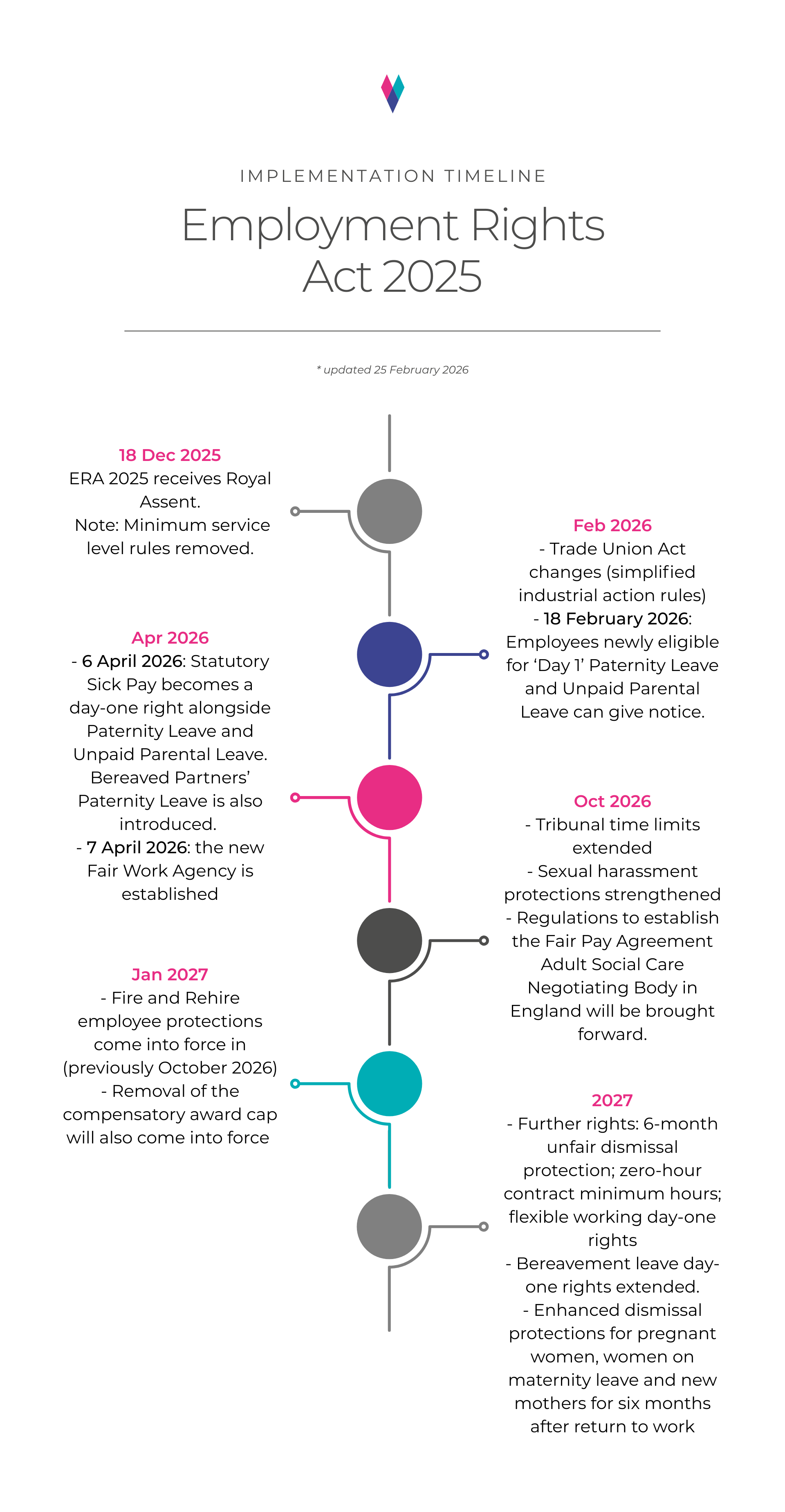
18 December 2025
Employment Rights Bill given Royal Assent and is now confirmed as the Employment Rights Act 2025. One right automatically applied from this date with rules around minimum service levels for strikes being removed instantly.
February 2026
Aspects of the Trade Union Act 2016 will be repealed; this change intends to simplify the law regarding industrial action and ballot notices.
April 2026
Statutory sick pay rights will be amended to being a right from day one of employment, there will also be a removal of the lower earnings limit meaning more workers will be entitled to sick pay.
Employees will have a day one right to paternity leave, and this will enable workers to essentially give notice of paternity leave from their first day of employment. Currently employees must have worked for their employer for 26 weeks to be eligible for paternity leave.
Ordinary parental leave will also become a day one right. Currently employees must have worked for their employer for 1 year to be eligible for parental leave.
The restriction on taking paternity leave after shared parental leave will be removed.
October 2026
Additional changes will be made around October 2026, subject to government consultations. Though this might seem a bit ambiguous as to what to expect at this stage, we do know that certain rights will come into effect here. Tribunal time limits are to be extended to 6 months by this point, fire and rehire practices will be limited, regulations will be introduced to establish the Fair Pay Agreement Adult Social Care Negotiating Body which will ratify a negotiating body’s agreement so its provisions regarding workers’ pay and terms and conditions are given legal effect, the body will also set out the relevant dispute resolution process.
By this point, employers must start informing their employees of their right to join a trade union; union rights will be strengthened as well regarding accessing the workplace to meet, support, represent, recruit, or organise workers, as well as the facilitation of collective bargaining. The updated law regarding workplace sexual harassment will also come into effect; employers are now to take all reasonable steps to prevent sexual harassment in the workplace including by third parties, and tight controls are to be implemented regarding non-disclosure agreements, with a total ban on those concerning harassment and discrimination in the workplace.
2027
2026 will be a significant year for implementing the various and complex aspects of the Employment Rights Act; as it stands 2027 is a bit more chronologically ambiguous, with most changes being subject to public consultations.
The following rights are expected to come into force during 2027:
- Six-month protection against unfair dismissal effective from 1 January 2027 (this is a significant reduction from the current qualifying period of two years continuous service). Notably, the extended unfair dismissal period was initially intended to be a day one right but has been extended to a six-month qualifying period;
- The removal of the unfair dismissal compensation cap on the compensatory award. Uncapped financial awards for successful claimants poses an increased risk for employers and will impact settlements and business costs;
- The provision of guaranteed minimum hours for workers under zero-hour contracts (under certain conditions);
- The strengthening of flexible working entitlements with day one rights to request flexible working;
- A day one right to unpaid bereavement leave; and
- The extension of prohibiting blacklisting based on employees’ trade union membership or activity.
Amendments are also projected regarding redundancy collective consultation. Currently, employers must start collective consultation if they propose 20 or more redundancies “at one establishment” within a 90-day period. From 2027, the at one establishment test will remain, however an alternative threshold test will apply. This new test will require employers to aggregate the total number of redundancies across all sites and workplaces within the whole organisation.
Why this matters
The Employment Rights Act 2025 is one of the most significant workplace reforms in recent years. For public sector organisations, these changes will influence workforce planning, budgets and organisational culture. Over the coming months, we’ll publish the following article series to help you anticipate what’s coming, understand how the legislation will affect employers and employees in the workplace, and take practical steps to prepare:
- Understanding the Implications of the New 6-Month Unfair Dismissal Rule: What It Means for Probation and Investigations
- Day-One Rights for Parental Leave: What Are the Challenges and Opportunities and How Can Policies Be Harmonised?
- What Are the Data, Privacy and Governance Implications of the Act? How Should NDAs and Records Be Handled?
- ERA 2025 in Education: Challenges and Practical Solutions for Schools
- How Will New Rights for Zero/Low-Hours Staff Affect Contracts, Rotas and Operational Planning?
- Moving Beyond Technical Compliance: Practical Steps for Cultural Change
- What Are the New Legal Boundaries for Changing Terms and Conditions? How Can Organisations Manage Change Lawfully?
- How Can New Reporting and Action Plan Duties Be Used to Drive Real Improvements in Retention and Workplace Culture?
- ERA 2025: What We’ve Learned and Priorities for 2026–27.
Key findings of CSG research
New research commissioned by Commercial Services Group has produced some diverse opinions as to the impending reforms, none of which are particularly unexpected given the gravity of the new Act.
While 69% of public sector leaders are confident their organisations can adapt to the reforms without major new funding, there’s a clear divide between larger authorities, who tend to feel well-prepared, and smaller service providers, who are more likely to highlight ongoing pressures on budgets and staffing.
The research also shows that employees are supportive of stronger rights, with 91% describing these protections as important. However, both leaders and staff recognise that real cultural change will take time, and that the success of the Act will depend on more than just new legislation.
Concerns remain about the practicalities of implementation, particularly around changes to zero-hour contracts, statutory sick pay and parental leave. Many leaders point out that careful planning and ongoing investment will be needed to avoid unintended strain on resources and to ensure that the reforms deliver genuine improvements in working life.
Ultimately, the findings suggest that while there is optimism about the direction of change, organisations will need to focus on leadership, staff development and open communication to turn the ambitions of the Act into everyday reality.
For more detail and practical recommendations, we encourage readers to consult the full Commercial Services Group research report here.
Conclusion
The Employment Rights Act 2025 marks a significant shift for the public sector, but the real test will be how these changes are put into practice. Over the next two years, organisations will need to move beyond compliance and focus on what these reforms mean day to day. Success will depend on clear communication, practical planning and a willingness to adapt. If organisations keep these priorities in mind, the Act has the potential to deliver lasting improvements for both employers and employees.
For a closer look at the new six-month unfair dismissal rule and what it means for probation and investigations, look out for the next article in this series, coming in March.
Disclaimer: This article, published 13 January 2026, does not constitute legal advice and is provided for general information purposes only. For support in reviewing policies or addressing specific queries, please reach out to our Employment Law team.